Vaughn College is excited to announce its Spring Open House happening on campus on Saturday, April 9 at 10 a.m. This in-person event is a fantastic opportunity to discover all the benefits of a Vaughn degree. See how one of our valuable degree programs in engineering, technology, management or aviation can lead you to an exciting, in-demand career.
So, who is “the future you” going to be? We’ll help you find out at our Open House.
What are the benefits of a Vaughn degree?
Futureproof guarantee
Vaughn graduates leave with more than just degrees. They leave with exciting, in-demand careers. We call it being futureproof. And we guarantee it. If you aren’t employed within one year of graduation, we’ll reimburse one year’s worth of federal Direct student loan payments. Now, that’s a guarantee!
Our stats: The numbers are stacked in your favor
Vaughn is ranked as among the top colleges in the country. We have raised the bar to provide an unprecedented education that will set you apart from the rest. Check out our fast facts:
Ranked number one in upward mobility in a study conducted by The Equality of Opportunity Project and reported by The New York Times. This proves Vaughn’s ability to move students from the bottom percentiles in income to the top.
Vaughn has been ranked as a best regional college in the North by US News and World Report for twelve consecutive years and a best college for social mobility (Source: US News and World Report Best Colleges)
Vaughn is one of only four colleges in the US that has an ABET-approved mechatronic engineering
88 percent of Vaughn graduates―75 percent in their field of study―are employed or continue their education within one year. In recent years, outside of a pandemic, Vaughn’s outcomes for students typically average more than 95 percent and have been 99, 98 and 97 percent for the three prior years.
Vaughn’s career services team is dedicated to helping students find internship and career opportunities through networking events, employer connections, professional associations, conferences and through the help of our caring and committed faculty, advisers and career services team.
Vaughn has small class sizes with a 14-to-1 student/faculty ratio. Committed faculty provide the personalized attention that students need to succeed. With experience working in the industry’s they teach, an added layer of inside knowledge and expertise gives students a competitive edge in the market.
More than 90 percent of Vaughn students receive some type of financial aid, and there are many financial aid and scholarship options available for incoming students.
Vaughn has a highly diverse student body, serves many first-generation college students and is recognized by the US Department of Education as a Hispanic-Serving institution
Vaughn is highly supportive of encouraging more women to enter the fields of engineering and aviation, which have historically been male dominated.
Where the jobs are
Vaughn graduates go further, faster. Our students go on to have exciting careers at some of the nation’s top companies in industries that include aerospace, engineering, airport/airline management and transportation. They also find rewarding opportunities in industries you may not expect, such as healthcare, utilities and sustainable energy. Here are some of the companies where Vaughn graduates have landed – you can click on the links to read the stories of graduates who have received employment at these companies.
The morning will kick off with a warm welcome from President Dr. Sharon B. DeVivo and Celso Alvarez, associate vice president of enrollment. You’ll learn about the College’s exciting degree programs and how Vaughn can help you be a part of the next futureproof generation. Additionally, you’ll hear firsthand success stories from some of our graduates—via our student outcomes video—on how their Vaughn degree landed them positions with some of today’s most sought-after industry leading companies.
Breakout sessions
You will have the opportunity to participate in breakout sessions in your program of interest. Led by the chair of each department, you will hear about Vaughn’s programs in engineering and technology, management, aviation or aviation maintenance (whichever you are interested in), learn about coursework and the types of jobs you’ll be eligible for upon graduation, see classrooms/labs and ask questions.
Closing presentation
The event will close with an admissions presentation, where you will hear about:
Students can get involved in clubs such as robotics and unmanned aerial vehicles (UAV).
There are several student chapters of professional organizations such as the American Association of Airport Executives (AAAE), Society of Hispanic Professional Engineers (SHPE) and Society of Women Engineers (SWE).
Become a Vaughn Warrior and get involved in athletics such as tennis, basketball, cross country and soccer.
Consider becoming a part of Vaughn’s residential community equipped with a full kitchen and TV lounge, multipurpose room and fitness center.
How to apply for FREE – Open House attendees receive a $40 application fee waiver
“Open House is an exciting time when we see and meet the future faces of our Vaughn community,” said Alvarez. “We look forward to a fun, informative and engaging event.”
To accept your invitation to meet the future you, register here. For those who are unable to attend the in-person Open House, there will be a virtual event held on April 21.
Note: Vaughn College requires proof of vaccination to be permitted in a campus facility.
In honor of Women’s History Month, Vaughn College celebrates the extraordinary lives and achievements of women who have paved the way for future leaders from all walks of life. In this special edition, we spotlight four inspiring women who have made their marks in the fields of engineering, management and aviation.
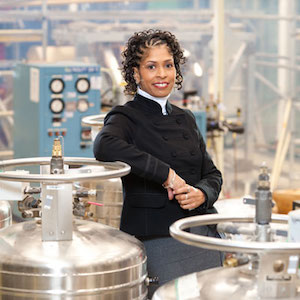
Aprille Ericsson-Jackson—Aerospace Engineer Who Has a Career of Firsts as a Black Woman
Photo Copyright: KEVIN ALLEN
With a distinguished career marked by “firsts,” Aprille Ericsson-Jackson, 58, has made impressive advancements as an aerospace engineer. Born April 1, 1963, in Brooklyn, New York, Ericsson-Jackson is the eldest of four sisters. She credits her achievements to her mother, who—from an early age—supported her career decisions.
After graduating high school with honors, Ericsson-Jackson attended Massachusetts Institute of Technology (MIT), where she earned a Bachelor of Science in Aeronautical/Astronautical Engineering. She overcame racial and gender bias to become the first African American woman to receive both a master’s degree in engineering from Howard University and a doctorate in engineering at the NASA Goddard Space Flight Center. Ericsson-Jackson recalls watching the Apollo missions growing up, which inspired her passion for science and space.
During her 25 years at NASA, she has held the positions of aerospace engineer, technologist, project and program manager and executive. She is credited with adding to the existing knowledge of our solar system and helping the effort to lead us to the future of space flight. Her work has included the design and development of instruments for spacecraft and satellites geared to help gain a better understanding of the Earth. In addition to her work as an aerospace engineer, Ericsson-Jackson teaches mechanical engineering and mathematics at Howard University and has also instructed at University of Maryland and Bowie State University.
Her dedication and excellence in the field has earned her a number of accolades. The National Technical Association named her one of the “Top 50 Minority Women Working in the Fields of Science and Engineering,” and in 2016 she was ranked number eight of 20 on the list of the “Most Powerful Women Engineers” by Business Insider. Her many honors and awards include an Honorary Doctor of Science from Medgar Evers College, The Women’s Network “Top 18 Women Who Will Change the World,” and the Tau Beta Pi Alumni of Distinction. But the one honor Ericsson-Jackson considers her most prestigious is being the first person of color to receive The Washington Award from the Western Society of Engineers.
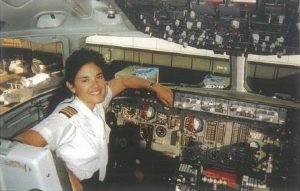
Beverly Burns—First Female Pilot to Fly a Boeing 747 Jet
Photo courtesy of Wikipedia
If you ever needed inspiration to become a female pilot, Beverly Burns would be it. Born in Maryland on August 15, 1949, Burns, 72, is best known as the first female pilot to command a Boeing 747—despite the rampant bias and chauvinism of the 1970s and 1980s. On July 18, 1984, she took her historic flight as a captain from Newark to Los Angeles.
As a young woman with a passion for aviation, Burns held several job titles in the industry—which included aircraft dispatcher, gate agent and baggage handler—before becoming a pilot. It wasn’t until she became a stewardess for American Airlines that her life took a drastic turn. One day, while listening to an American Airlines first officer giving a speech to fellow crew members, she heard him say: “Women are just not smart enough to do this job.” That statement fueled Burns’ determination to become a captain. During her seven years working as a stewardess, she attended flight school—where she unfortunately was faced with more bias. She went through eight instructors until she found one who took her seriously: Captain Robert Allen Burns, whom she married in 1972. In 2008, Burns retired after having worked for 27 years with People Express, which merged with Continental Airlines in 2000. Over the years, she operated some of the industry’s most impressive aircraft, including the DC-9, DC-10, Boeing 757 and Boeing 767. Then, in May 2001, her ambition and superior cockpit skills landed her in the captain’s seat of the Boeing 777—the most technologically sophisticated aircraft of its time. Over the course of her career, Burns received several awards and commendations. These include the Amelia Earhart Award for her historic flight, a congratulatory letter from President Ronald Reagan (along with an invitation to the 50th American President Inaugural), a 2001 citation from US Senator Barbara Mikulski of Maryland and a letter of congratulations on her service from President George W. Bush, among many others.
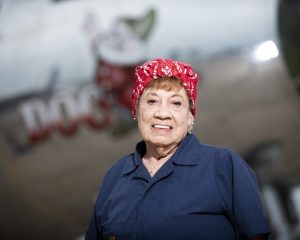
Connie Palacioz—A Real-Life “Rosie the Riveter”
Photo courtesy of b29doc.com
At 95 years young, Connie Palacioz is known as a real life “Rosie the Riveter” for her amazing work on the B-29 Superfortress at Boeing in Wichita, Kansas during World War II. Born in Peabody, Kansas (but raised in Newton), Palacioz worked hard for her family, working as a laundress earning $0.25. per hour.
After graduating from high school in 1943, Palacioz joined the war effort at the age of 18, where she trained for three weeks to work as a riveter, earning $0.50 per hour. Helping with the war effort was important to Palacioz, as she had several family members in the service, including her brother who was serving in the United States Navy. Her first day on the job was also the day when the B-29 was introduced. She and her bucker, Jerri Warden, were assigned to work on the noses of the B-29s. Together with their team, they produced four B-29 nose sections per day. Her hard work earned her a raise to $1.00 per hour—which was considerably more than she was earning as a laundress only a few years before.
In 1944, Palacioz was asked to be part of the team that manufactured the famous B-29 known as “DOC.” When the war ended, she was laid off from her job. In 1946, she married her fiancé and moved to Emporia, where she and her husband attended college through the G.I. Bill and started a family. Nearly 60 years later, she was surprised to learn that the B-29 nicknamed “DOC”—which she worked on decades earlier—was discovered in the Mojave Desert after having been there for 42 years. Interestingly, DOC was found in pieces—except for the nose of the plane, which only suffered a broken window! In 2000, DOC was returned to Wichita, where Palacioz and other volunteers formed a team and worked for 16 years on its restoration. In 2016, they witnessed how their work paid off when they watched DOC return to the skies. Today, Palacioz not only remains an active volunteer at the DOC hangar in Wichita but is a regular member of the team that travels with DOC to airshows around the country.
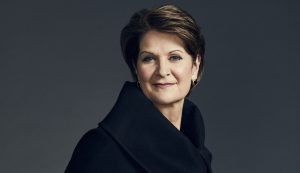
Marillyn Hewson—Former CEO of Lockheed Martin
Fortune Magazine, Women in Defense
Born in Junction City, Kansas on December 27, 1953, Marillyn Hewson, 67, is the former CEO of Lockheed Martin and arguably recognized as one of the world’s most powerful women. She credits her mother’s resilience, hard work and determination for teaching her the leadership skills that brought her where she is today. After Hewson’s father died when she was only nine years old, her mother, a former member of the Women’s Army Corps (WAC)—the women’s branch of the United States Army—raised her and her four siblings. Hewson is quoted as saying: “My mother did what all great leaders do: She sparked the growth of future leaders.” She earned her Bachelor of Science degree in Business Administration and her Master of Arts degree in Economics from the University of Alabama. She eventually went on to attend the Columbia Business School and Harvard Business School executive development programs.
Prior to joining Lockheed Martin in 1983 as the company’s senior industrial engineer, Hewson worked as an economist at the Bureau of Labor Statistics for four years. She held several executive positions that included president and chief operating officer (COO), executive vice president of Lockheed Martin’s Electronic Systems Business Division, president of the company’s Systems Integration and executive vice president of Global Sustainment for Lockheed Martin Aeronautics, among others. In 2012, Hewson was elected to join the company’s board of directors. She eventually accepted the position of chief executive officer (CEO) in 2013, a position she held until June 2020. It’s impressive to note that during her tenure as CEO, Lockheed Martin’s stock value increased by more than 300 percent.
On March 1, 2021, she retired as the company’s executive chairman and board member. Hewson’s stellar leadership achievements have placed her among the most powerful women in business. Fortune magazine named her as one of the “50 Most Powerful Women in Business” in the years 2010, 2011, 2012 and most notably, 2015—when she ranked fourth place. In 2018, Hewson took the top spot with Fortune, which named her as the “Most Powerful Woman in the Business World.” That same year, Chief Executive Magazine named Hewson “CEO of the Year,” and she was awarded the Edison Achievement Award for her leadership skills and achievements in making a lasting contribution to the world of innovation. In 2019, Time magazine named Hewson in its list of the “100 Most Influential People of 2019.”
We hope you enjoyed reading about these extraordinary and inspiring women. What inspires you to be your best? A degree from Vaughn College can get you there. Whether your passion is in engineering and technology, management or aviation, Vaughn will be by your side throughout your journey. Apply today.
Want to learn more about Women’s History Month? Check it out here.
February is Black History Month. It is a time when we celebrate the achievements of African Americans and recognize their notable contributions to our country and its history.
To honor this special time, we are featuring influential African Americans whose lives, careers and pioneering efforts in the fields of engineering, aviation and management continue to pave the way for future generations.
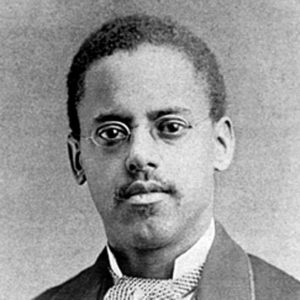
Lewis Latimer: Notable Inventor and Engineer Who Helped Edison and Graham Bell on Their Revolutionary Inventions
Lewis Howard Latimer, 1882. Photo courtesy of Queens Borough Public Library
Born in Chelsea, Massachusetts in 1848, Lewis Latimer was an engineer and inventor best known for his contributions toward the development of the light bulb and the telephone—although his achievements go way beyond those. Thomas Edison and Alexander Graham Bell may come to mind when you hear about the invention of the light bulb and telephone, respectively, but it was the innovative insight and drafting expertise of Latimer that helped these renowned inventors obtain their patents on two of the most fundamental inventions of modern life.
The youngest of four children, Latimer, lied about his age and enlisted in the U.S. Navy during the Civil War at 15 years old. He was honorably discharged one year later and returned to Boston, where he was hired as an office assistant at a patent law firm. It was there that Latimer saw an opportunity to teach himself mechanical drawing and drafting by observing drafters at the firm. He worked himself up to head drafter and used his design skills to invent other ways to improve on existing life. It was during this time that Bell sought out Latimer to do the drawings for his patent application, which ultimately awarded him the patent rights to the telephone.
Considered one of the most important Black inventors of his time, Latimer was in demand as the need for electric lighting spread throughout the country. He co-authored a book, “Incandescent Electric Lighting: A Practical Description of the Edison System”. Although he never worked in any of Edison’s labs, Latimer was the only Black member of “Edison’s Pioneers”—a group of men who worked closely with the famous inventor during his early days. He married Mary Wilson and had two daughters, Emma and Louise. He died on December 11, 1928, in Flushing, New York.
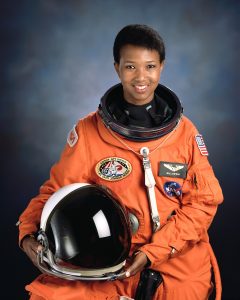
Mae Jemison: Aerospace Engineer and Physicist and First Black Woman Astronaut to Travel to Space
Photo Credit: Courtesy NASA, [Public Domain] via Wikimedia Commons
Born in Alabama in 1956, Mae Jemison—an American engineer, physician and former NASA astronaut—was raised in Chicago. She became the first Black woman astronaut and the first Black woman to travel to space. At the age of 16, she enrolled at Stanford University and earned degrees in both chemical engineering and African and African American studies.
Jemison’s aspirations to become a professional dancer and desire to go to medical school left her at a crossroads during her senior year at Stanford. As history revealed, she went on to earn her medical degree from Cornell University while continuing to study dance during her time there.
From 1983 to 1985, Jemison worked as a medical officer for the Peace Corps in Liberia and Sierra Leone, where she held several responsibilities that included supervising the medical staff, providing medical care and conducting research. Over the next few years, she entered private practice and took graduate-level engineering courses in preparation to fulfill her childhood dream of someday going into space.
In 1987, she was accepted into NASA’s astronaut training program and became the first Black woman astronaut. On September 12, 1992, Jemison became the first Black woman in space, where she served as a science mission specialist aboard the Endeavour, which orbited the Earth for nearly eight days. After leaving NASA, she founded the Jemison Group, Inc., a technology research organization. She has received several honorary degrees and awards, including the National Organization for Women’s Intrepid Award and the Kilby Science Award. Additionally, Jemison has been inducted into the National Women’s Hall of Fame, the National Medical Association Hall of Fame and the Texas Science Hall of Fame. She currently lives in Houston, Texas.
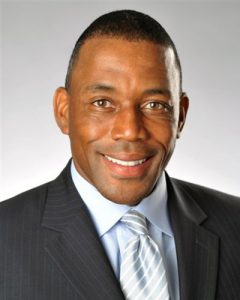
Henry Kuykendall: Senior Vice President of Airport Operations, East at Delta Airlines
Photo courtesy of nyrej.com
As Senior Vice President of Airport Operations at Delta Airlines, Henry Kuykendall is a shining example of how diversity, inclusion and equity play a significant role in becoming a successful cross-divisional leader in the aviation industry. As someone who worked his way up the corporate ladder, Kuykendall has firsthand knowledge of the importance of understanding the complexities his peers face, since he once walked in their shoes.
From a position of facing professional challenges as a member of the Black community, Kuykendall knows that understanding differences comes power. He believes the best way to “get a seat at the table” and create opportunities to learn is to insert yourself with leaders who are innately different from you. This notion has proven successful for Kuykendall over the years. In 1988, he joined Delta and worked in several positions that included airport customer service, airport operations and corporate and reservation sales. His arduous work over the years earned him a position at Delta’s hub at Hartsfield-Jackson Atlanta International Airport, where he led a team of 4,000 employees.
In 2011, he moved to New York, where he served as vice president for Delta, overseeing all New York routes and commercial functions for the business in that state. His career continued to take off when he was appointed Senior Vice President of Airport Operations, Northeast, where he oversaw Delta operations at LaGuardia Airport, John F. Kennedy International Airport, Newark Liberty International Airport and Boston Logan International Airport. In 2017, he assumed his current position as Senior Vice President of Airport Operations, East, where he not only oversees all airport operations in Boston, New York and Detroit Metropolitan Airport, but 42 airports in the East, not to mention 134 smaller airport locations across the United States. Kuykendall is a graduate of West Los Angeles College and the University of Phoenix. He serves on the board of directors for the YMCA of Greater New York and the New York Building of Congress.
You can read more about other Black pioneers who made their marks in history in this blog. Which one of these amazing trailblazers inspired you? Just imagine: You could create the next revolutionary invention or explore space as a next generation astronaut! Your dreams are possible with a degree from Vaughn College. We offer programs in the fields of engineering and technology, management and aviation that can set you on a path of a futureproof career. Discover the possibilities. Apply today.
Following in the family footsteps has been an inspiring journey for Vaughn graduate, Mahdi Macbahi ’13, and his two brothers. As fate would have it, their father’s trade as a carpenter was the steppingstone to pursuing degrees in the aviation maintenance industry by studying at Vaughn College.
This month, we spotlight Macbahi and the story of how his aviation maintenance management degree from Vaughn was instrumental in not only helping him land his current position at Delta Air Lines, but also in helping him become an instructor at the College as well.
Family connections
Growing up in Astoria, New York, Macbahi always had a passion for aviation. From a young age, he dreamed of becoming a pilot. It wasn’t until he reached high school, however, that he decided to pursue a career in aviation maintenance. “Being that my dad was a carpenter, I loved working side-by-side with him on the weekends, helping with his projects,” said Macbahi. “It was during that time that I honed my skills and knew I wanted a job that would combine the two things I loved the most—working with my hands and aviation.”
Discovering Vaughn
Knowing how eager Macbahi was to earn his degree, a family friend recommended Vaughn as the perfect institution for him to pursue his degree. “I knew about Vaughn College from doing my own research and seeing advertisements but hearing about it from our close family friend really sealed the deal for me.” In 2008, Macbahi enrolled in the College’s Aviation Training Institute, where he pursued an associate degree in occupational science (AOS) in aviation maintenance and then went on to earn his bachelor’s degree in aviation maintenance management. “As someone who loves to work with his hands, I knew I chose the right path,” he said. “At Vaughn, you get your hands dirty and learn as you go. That’s what makes this program so special. The program teaches you how to be a better technician—a better mechanic.”
Nurturing a new passion at Vaughn
As he pursued studies toward his own degree, one of Macbahi’s advisers offered him a tutoring position to help fellow students. “I never thought of myself as a teacher but tutoring gave me an entirely new perspective on a career path,” he explained. After completing his associate degree, Macbahi inquired about becoming an assistant instructor in a sheet metal class. “I was thrilled to learn I would be working with my professor in one of my favorite classes,” he said. With a new position at the College and his newly earned associate degree, it was time to get to work. For the next four years, he worked for regional airlines at LaGuardia Airport—all while working toward his bachelor’s degree. Then, life really took off for Macbahi!
Blending passions
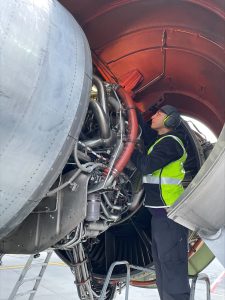
Shortly after graduating with his bachelor’s degree, Macbahi accepted both a new position at Vaughn to teach a hydraulics lecture class, as well as one at Delta Air Lines—stationed at John F. Kennedy (JFK) International Airport—where he has been working for the past seven-and-a-half years. “It’s a big operation at JFK,” he said. “With approximately 230 mechanics, we all have a busy schedule, but I love it. The best part about my job is we learn something new every day.” He says that although his job is demanding, his schedule is flexible enough to accommodate being able to teach at Vaughn. “I never imagined I would discover a new passion of teaching while pursuing my dream in the aviation industry. I suppose you can say I found success by blending my passions.”
How Vaughn made it all possible
At 30-years old, Macbahi says that when reflecting on his life, he owes a great deal of gratitude to Vaughn for making his career possible. “Vaughn gave me the skills and mindset to prepare for a career in the aviation industry,” he said humbly. “Not only am I living my dream—working in the industry—but I’m providing real-world experience to the future generation of aviation mechanics.” As for his personal life, he said he’s grateful for the opportunities provided to him to support his wife, Methela, their young son and a new baby on the way.
Bringing life full circle, Mahdi says his father’s craft as a carpenter and his success at Vaughn not only influenced his career but that of his two younger brothers. “My brother Ali also graduated from Vaughn with a bachelor’s degree in aviation maintenance management, and our youngest brother Rida is currently enrolled at Vaughn, pursuing his AOS in the Airframe and Powerplant program,” he explained. “Our dad, Abdelillah, may not work in the aviation industry, but his strong work ethic, knowledge and skills in craftmanship have molded us into the men we are today.”
Are you thinking about attending college but not sure how to find the right one for you? Attending an open house is a great place to start.
Attending an open house is so much more than mixing and mingling. It’s the perfect opportunity where you can walk through doors to your future with everything you need to know—and everyone you want to meet—all under one roof. (Think of it as a warm welcome through the front door of your potential new home.) So, what is the key to getting the most out of a college visit or open house? The answer is simple: Asking the right questions.
We’ve done the homework for you and put together an easy guide of the top questions to ask at your next college visit or open house. We even left space for your notes so you can compare when it’s decision time!
We understand you might be feeling a bit nervous. The good news is you’re not alone. One of the greatest benefits to attending an open house is so you can get a feel for the campus, faculty, community and get all your questions answered in an unbiased, nonjudgmental environment.
Vaughn Open House
A degree from Vaughn College is not just a degree. Think of it as a passport to your future. Attending our open house is your first step toward landing a futureproof career. This year, we’re hosting two events – an on-campus event on Saturday, November 13 and virtual event on Tuesday, November 30. This way, you have the option to attend virtually if you can’t make it to campus. As space is limited, you must register now for the in-person event.
In-person Open House:
Saturday, November 13 at 10 a.m.
Virtual Open House:
Tuesday, November 30 at 6 p.m.
Why a degree from Vaughn is your ticket to the future
Who is “the future you” going to be? At Vaughn, we’ll help you find out. Our graduates leave with more than just degrees. They leave with exciting, in-demand careers. We call it being futureproof. And we guarantee it. Learn about the details of our guarantee and eligibility.
Don’t take our word for it! Read the success stories of so many students who graduated from Vaughn and have landed their dream career.
We hope to see you at our open house!
From humble beginnings as he learned the English language to working as a SpaceX engineer, Joan Cruz ’20, a Vaughn College mechanical engineering graduate chronicles how his career path found him in a way he least expected.
Coming to America
At the age of seven, Cruz moved to the United States with his mother from the Dominican Republic to join his father and sister who had settled in Maryland. He attended elementary school with the added challenge of learning the English language. Cruz said within six months he broke the language barrier and began making friends. Shortly after, they moved to Queens, New York where Cruz went on to attend Forest Hills High School. “My parents worked hard to give me and my sister a good life in the United States,” Cruz said. “I am grateful to my parents for their efforts to give us the opportunity for a better life.”
Finding his way
Throughout high school, Cruz said he was an average student who did not have a clear vision of what career path he wanted to pursue. “My father encouraged me to become an engineer. He saw something in me that I didn’t—a vision and problem-solving skills that would be best applied in an engineering career. Sadly, I didn’t have the confidence then,” he admitted. “I didn’t think I was engineering material.” Little did Cruz realize that within a few short years he would be working as an engineer for Space Exploration Technologies Corp—which is more popularly known as ‘SpaceX.’
What Cruz did know, however, was that he wanted to live an independent life. At the age of 18, shortly after graduating from Forest Hills High School, he joined the United States Army. “I needed direction and discipline in my life,” he said humbly. “I needed to grow up.” He explained how boot camp was the hardest thing he ever experienced in his life but was well worth it. During his three years of service, Cruz worked as a diesel mechanic in a combat engineering unit. “I loved working as a mechanic,” he said. “I was thrust into this field and discovered talents I didn’t know I had.” Unfortunately, Cruz suffered an injury that cut his military service short. “I was disappointed my time in the army was coming to an end, but I was excited to begin a new chapter in my life. Working as an engineer seemed like it could become a reality. It was then that I discovered Vaughn College.”
Discovering Vaughn
During his last six months of military service, Cruz began researching colleges that had a focus on engineering and aerospace. “As far-fetched as becoming an engineer was for me then, becoming a pilot was even more of a dream—but one I took seriously,” he said. He applied to several colleges and decided on Vaughn to pursue his engineering and aerospace career. In the fall of 2017, Cruz began the mechanical engineering degree program at Vaughn. He explained how the program, although challenging, gave him the skills to land his job as an associate engineer at SpaceX. Cruz pointed out two of his favorite things about Vaughn: The one-on-one relationship students have with their professors and the small class sizes. “The opportunity to ask questions without judgment and faculty support were driving factors in my success,”he said. “I admit I needed some motivation to keep the momentum going. College is a test of your skills, and Vaughn has the perfect formula to cultivate a student’s success.”
During his time at Vaughn, Cruz was a proud member of the Vaughn student chapter of Engineers Without Borders. He, along with three other Vaughn engineering and technology students, were part of the team led by Miguel Bustamante, PhD, assistant professor of engineering and technology. Together, the group visited the African country of Rwanda to test water supplies in the village of Kibingo. (Read more about their incredible efforts here.)
Cruz completed his bachelor’s degree in mechanical engineering in less than four years—but not without earning his pilot’s license, too! “The military ‘can do’ mentality gave me the discipline and determination to work through the summer and both my winter and spring breaks to earn my pilot’s license by my senior year,” he said triumphantly.
‘Launching’ his career
Cruz was determined to land a job before graduating from Vaughn. He sent out several job applications, including one to SpaceX for the position of associate engineer. To his surprise, he received an invitation to interview with SpaceX. Over the course of two months, the excitement and anticipation grew as Cruz completed four interviews in the hope of landing the job at the Kennedy Space Center in Cape Canaveral, Florida. In November 2020, Cruz was offered the position of a lifetime, and he moved to Cape Canaveral right after graduating from Vaughn. “I was over the moon to hear the news that I would be working at my dream job,” he said excitedly. Cruz’s responsibilities included working on all hardware for launch pads, tooling and rocket recovery. “I’m convinced that my combined experience and knowledge that I gained at Vaughn, earning my pilot’s license, the Rwanda project with Engineers Without Borders and my veteran work experience were the winning combination to landing my current job.”
Living the dream
After only three months, Cruz was promoted to the position of manufacturing engineer at SpaceX, where his responsibilities include delivering a fully scalable working piece of hardware for a successful SpaceX rocket launch manifest, among other tasks. “The magnitude of responsibility is immense,” he explained. “We all work long hours, but we love every minute of it.” Cruz points out how SpaceX is a positive environment where everyone takes ownership of their work and has an integral part of the process. “Anything worth doing is worth overdoing,” he said emphatically. “If you told me years ago that I would be working as an engineer—building launch hardware components for rocket ships—I would have told you you’re crazy,” laughed Cruz. “I believe everything happens for a reason. Joining the army, and then finding Vaughn were the steppingstones I needed to launch a career I could only dream of.”
Do you have a passion for engineering or aviation? A degree from Vaughn College can be your launching pad for a futureproof career. Apply today!
Are you looking for a fun and exciting way to spend your summer while preparing for a successful college career? Vaughn College is excited to announce a new six-week “Propel Forward Summer Institute” where students will learn to fly drones and prepare for a successful college experience in engineering and technology, management or aviation. You can even earn college credit and have a blast doing it. And the best part—the program is totally free!
About the program
The program was created to introduce high school students to drone technology and remote pilot operation while also providing extra support in mathematical skills to help them get on course for college success. Plus, it’s a great opportunity to explore the possibilities of a futureproof career in engineering and technology, management or aviation—all in a fun, engaging, in-person setting on Vaughn College’s campus in New York City. Please note that COVID-19 vaccination is strongly recommended in order to fully participate in the program.
Propelling your future to new heights
A career in engineering and technology, management or aviation can take your future to new heights. And what better time to start preparing for an exciting future than by spending this summer at Vaughn? You’ll experience college life on our state-of-the-art campus, which is steeped in aviation history and designed with the very best hands-on technology. Here’s a snapshot of what you’ll experience:
The program centers on drone technology, remote pilot operation and college-readiness skills with some brushing up on your math skills—which is an important part of being successful in any career.
Learn from top professors who have real-world experience in their fields, which will give you the inside track on career outlooks, industry know-how, current trends and the skills required for success in the field.
Your daily schedule
From Mondays through Thursdays, students will take their required classes, which will prepare them for a high-flying experience on Fridays. Students can return home on weekends. Here’s what you can expect:
Monday through Thursday—8 a.m. to 3 p.m. (academic classes)
Students will meet for breakfast at 8 a.m. All students will be taking the Drone Laws and Remote Pilot Certification course and one of three math courses offered to assist their career aspirations and to help them succeed in college. Evening activities will take place in Vaughn’s residence hall.
Friday—9 a.m. to 2 p.m. (activities day)
Students will meet for breakfast at 9 a.m. Then, let the fun begin! Students will practice flying drones, compete with fellow classmates and prepare for the Federal Aviation Administration (FAA) exam. They will engage in instructional and fun activities that are centered on social skills, study habits and college life.
What you need to know
Who can attend?
Rising high school seniors and recent graduates who are 16 years of age or older.
Where is it located?
The program will be held on the Vaughn College campus, located in Flushing, New York. Students will stay in Vaughn’s residence hall for FREE Monday through Friday (meals included) and return home on weekends.
When does it happen?
The six-week program begins on Monday, July 12 and runs through Friday, August 20.
What is the cost?
All costs are covered!
Why is the program free?
Programs like this are funded by the Cares Act, along with grants from the United States Department of Education which have a goal of helping students whose education was impacted by the pandemic.
When is the deadline to register?
The registration deadline is July 2. Space is limited. Register today!
Signing up is easy! Here what you need to do:
Show us how this program gets you excited about college and your future in aeronautics by posting a 30-45 second video on Facebook or Instagram that’s tagged @vaughncollege. Tell us all about why you want to be a part of Vaughn’s “Propel Forward Summer Institute.”
Submit your application HERE. You can also send an email to if you have any additional questions.
This summer program can set you on a fast-track towards attending college and graduating with not only a degree, but a career in your field. We are so confident that you’ll achieve success and graduate with a futureproof career that we actually guarantee it.
Welcome to a special edition of the Vaughn College blog. As the world celebrates Pride Month throughout June, we’d like to connect our LGBTQ+ community with the National Gay Pilots Association (NGPA) – the largest organization of lesbian, gay, bisexual and transgender aviation professionals and enthusiasts from around the world. This organization provides resources, career connections, supplementary education, financial and networking support to LGBTQ+ aviation students and professionals. Here, we’ll dive into what the NGPA does, the various resources it offers and how you can get involved.
What is the NGPA?
Founded in 1990, this charity organization has built its membership by staying true to its mission to build, support and unite the global LGBTQ+ aviation community through education, social events, advocacy and outreach.
What the NGPA does
The NGPA encourages members of the LGBTQ+ community to start their careers as pilots by providing a place where they can pursue their passion for aviation and connect with like-minded professionals and students. The organization promotes aviation safety, addresses concerns regarding homophobia and provides a social and professional network for the LGBTQ+ aviation community. The NGPA accomplishes these goals through advocacy, inclusion training and by hosting special events, expositions, and webinars throughout the year.
Events
The NGPA hosts several events every year including its Industry Expo, Palm Springs Winter Warm-Up and the Cape Cod Classic held in Provincetown, MA. The NGPA Industry Expo is the organization’s largest event and features keynote speakers, aviation products and services, and serves as a place for hundreds of ATP-qualified active pilots to seek employment. It has grown to be the second-largest annual pilot recruiting and aviation networking event in the United States, after the EAA AirVenture Oshkosh. This is huge!
The NGPA connects aviation enthusiasts, members of the military, women, families, flight schools and others. It is all about building a safe community. Those who choose to join the NGPA as members can receive counseling services, mentorship, access to jobs, podcasts, publications and more. The NGPA’s Advocacy Council is available to help anyone who has experienced discrimination in the industry, needs training or consultation on policies or procedures.
The NGPA also offers a student membership for $20 per year for a maximum of two years available to students enrolled in a full-time flight training program at a community college, university, or flight school. Some of the benefits include membership in the University Chapter, discounts to NGPA events, subscription to Contrails magazine, access to aeromedical resources and counseling, and access to job postings and forums.
The history of Pride Month and Pride Day
Pride month is celebrated around the world every June to acknowledge those who were involved in the 1969 Stonewall Riots in Greenwich Village, New York. More recently, it has become a time when the LGBTQ+ community gathers to celebrate progress and spread awareness. Pride Day is celebrated on June 28 as the day when the first Pride march was held more than 50 years ago in New York City.
Vaughn proudly celebrates Pride Day and Month, and has a Gay-Straight Association (GSA) on campus which aims to create a safe and welcoming LGBTQ+ inclusive community for all students. The GSA is a student-led club that provides a supportive environment for lesbian, gay, bisexual, and transgender students and their allies.
Scholarship opportunities
The cost of pursuing a career as a pilot can deter students from achieving their dreams. The NGPA can help. The organization gives thousands of dollars in scholarships every year to aspiring aviators. Support and memorial scholarships cover everything from private pilot’s licenses, aviation maintenance, technical and academic studies and advanced pilot training. The application window for summer 2021 scholarships will open on June 15, 2021 – we encourage you to apply!
As Vaughn College continues to celebrate Asian American and Pacific Islander (AAPI) Heritage Month, we are pleased to highlight Vaughn mechatronic engineering graduate Ryan Tang ’17. We caught up with Tang to hear his inspirational story after graduating from Vaughn and how his journey post-graduation has circled back to the classroom.
Steeped in his roots
Tang is proud of his Asian heritage and says being raised with strong cultural connections by his Taiwanese parents gave him the confidence he needed to be the inspirational professional he is today. Born in Ecuador, Tang explained how at an early age, his parents insisted he learn their native language of Mandarin. “We speak Mandarin in our household,” Tang said. “I’m grateful to my parents for being strict with me about learning our language. Being fluent in Mandarin is giving me a competitive edge in my career.”
Finding his passion
Even at a young age, Tang said he loved engineering, and says that his high school experience led him on the path to becoming an educator and mentor. “I believe my high school years fed my inner passion to want to help students, particularly in science, technology, engineering and math (STEM) programs,” Tang explained. “My sisters are educators, so I suppose this passion to teach runs in our family,” he continued.
As a lover of robotics, Tang discovered Vaughn and was drawn to its mechatronic engineering program. “I knew Vaughn was the perfect college for me,” Tang said. “Sharing my passion for engineering and robotics with my classmates who were equally as excited gave me the inspiration and encouragement to excel.” Tang quickly made his mark on campus. In 2015, he co-founded the unmanned aerial vehicle (UAV) team, which he remains involved with to this day as a consultant and adviser. Tang said it was this type of role—as mentor and teacher—that shifted his path from future engineer to educator.
Teaching mechatronic engineering
After graduation, Tang didn’t need to go far to land his first job. He began teaching at Vaughn as an adjunct professor, leading courses in robotics and mechatronic engineering. “I owe my passion for both teaching and engineering to my Vaughn professors, Dr. Rahemi and Dr. He,” he said humbly. “Their dedication to their students’ success inspired me to do the same for others.”
Tang decided to take his passion for learning one step further and is pursuing a master’s in engineering education. “It was important to me to continue my education in both engineering and education,” he explained. “I want to be the best I can be for my students.”
Currently on the weekends, Tang works as the head coach and STEM coordinator at KG CompuTech, a computer-training center for young students in Flushing, Queens where he teaches computer technology and robotics to middle school and high school students. “I love motivating and encouraging my students to learn critical thinking skills. They love competing in the robotics competitions.” Tang says his students see him as combination of drill sergeant and big brother. “I work my students hard to keep them focused, but I always make it a point to spend time with them after our work is done. They need to talk, and I’m there to listen and mentor them. It’s a rewarding profession and I wouldn’t want it any other way.”
His advice to students
As an Asian American, Tang said he’s proud to be represented during AAPI Heritage Month. Coming from an Asian American household, he encourages students to embrace their culture, work hard, stay motivated and not fall behind.
When asked why he chose to teach engineering instead of working as an engineer, his answer was simple: “It’s more rewarding to inspire 100 students to become engineers than to work in the field as one person. There’s power in numbers. I believe motivating and encouraging students to pursue their dreams is the perfect equation to creating a future of leaders and innovators.”
Vaughn College’s core values place an emphasis on embracing diversity in all of its dimensions. We offer some of today’s most sought-after degrees in engineering and technology, management and aviation. Find out where a Vaughn degree can take you. Apply today!
Welcome to a special edition of the Vaughn College Blog. This month, we’re celebrating Asian American and Pacific Islander (AAPI) Heritage Month and recognizing Asian and Pacific Island Americans at Vaughn who are preparing for futureproof careers and whose heritage has made a powerful impactful on their experience and growth. See why choosing Vaughn has given them a place to feel excited and empowered.
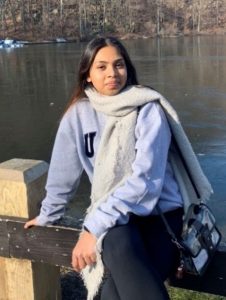
Sadia Afrin: Breaking gender and cultural barriers
Sadia Afrin’s ’24, Aircraft Operations
Breaking gender and cultural norms are the driving forces behind 19-year-old Vaughn student Sadia Afrin’s ’24 journey, as she pursues a career in aircraft operations with the hope of someday becoming a commercial airline pilot. Born in the United States and raised in the South Asian country of Bangladesh, Afrin always knew she wanted to become a pilot but realized it would take determination and the right institution to make it happen.
At the age of 15, she moved to New York with her family and attended high school in Queens. Her passion for flying was prevalent throughout her high school years, but she was aware of the gender disparities that she would need to address as she pursued this path. “In some cultures, life and careers are gender-specific,” Afrin said. “Becoming a pilot was not on my radar as a child. It was important to me to break that barrier and pursue my dream. Settling for another profession was not an option for me. That’s when I found Vaughn College.” As the oldest of three girls, Afrin said she feels a responsibility to her younger sisters to lead by example and pave the way for more diversity in aviation. “One of the greatest things about Vaughn is the campus’ diversity. Everyone is so friendly and welcoming. I never felt out of place.”
When it comes to flying, she said there’s no greater feeling. “You forget all your problems on the ground. You’re living in the moment. It’s empowering.” Afrin said the key to unlocking her dream of becoming an Asian female pilot was never allowing traditional gender roles to stand in her way. She instead took those challenges and used them as her motivation and inspiration to pursue her career. She said she is grateful to her parents for supporting her dreams. Becoming a female pilot may not be part of her culture’s traditions, but she hopes that—someday—her goal of flying for a commercial airline will inspire other Asian American girls to follow their dreams, too.
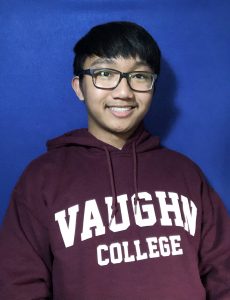
Anton DeGuzman: Building a dream
Anton DeGuzman ’24, Mechatronic Engineering
For 19-year-old mechatronic engineering major Anton DeGuzman ’24, having a curious mind about how things are built is just one of the reasons he’s pursuing an engineering degree at Vaughn College. Another reason: diversity. Although he was born in Saudi Arabia, DeGuzman’s family is from the Philippines and they moved to Corona, New York when Anton was only three years old. And even at that early age, he was fascinated with how things worked.
In high school, he began researching the best colleges for his future when he discovered Vaughn. “I was very impressed with Vaughn College. It’s one of only a few colleges in the country that offers a mechatronic engineering degree that is accredited by the Engineering Technology Accreditation Commission of the Accreditation Board for Engineering and Technology (ABET),” DeGuzman said. Being able to afford a college education was a concern, as it is with most students. During his senior year of high school, DeGuzman applied for—and was the recipient of—one of five Port Authority of New York and New Jersey Scholarships, which rewards selected students with a full four-year scholarship to Vaughn, paid summer internships and a guaranteed job after graduation in a “futureproof” career. “I was shocked and thrilled when I received the news of receiving the scholarship,” DeGuzman said excitedly. “I knew I was on my way to pursuing my dream career.” Knowing he had college paid for was a huge weight off his shoulders, but his concern for inclusion was his last hurdle. “Diversity played a major role in deciding on Vaughn to pursue my degree. Being a part of the Vaughn community made me feel welcome and safe. As an Asian American, I found a place where I knew I would fit in. That was important to me.”
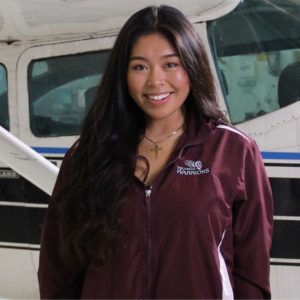
Alexa Rae Cruz: Leading the way for women
Alexa Rae Cruz ’22, Aeronautical Science
At 21 years old, Vaughn aeronautical science student Alexa Rae Cruz ’22 says pride, leadership and an ‘A-ha!’ moment defined her goal of becoming a pilot. “As an Asian American, I always felt a sense of pride and responsibility to lead the way for other Asian girls like myself,” said Cruz. She explained how her mother and stepfather were both shoe designers who travelled extensively for their jobs. Growing up, Cruz would travel with her parents. She enjoyed her time at different airports where she watched the planes take off and land. “One day, I was sitting in the window seat of a plane and had an ‘A-ha!’ moment. That was the day I knew I wanted to work in the aviation industry.” She said she never imagined she would aspire to become a pilot, since she had close ties to the fashion industry and the medical field. “I knew at an early age that the medical field or the shoe business would not be the paths for me,” said Cruz. “You could imagine my parents’ reaction when I told them I wanted to be a pilot!” Cruz said her parents are supportive of her decision and want her to live a life that makes her happy. She emphasizes her love for her family and states that these strong bonds kept her close to home when applying to colleges. She chose Vaughn for its diverse student community and said living on campus (prior to the COVID-19 pandemic) was a great experience.
“The student diversity brings so many unique perspectives to Vaughn,” Cruz explained. “It’s what brings the College to life!” Her leadership qualities have paved the way for her passion to be a role model for other AAPI women. “You don’t see many women of our culture in the industry right now,” Cruz said. “I feel the responsibility to represent my generation and be that person to help others feel like they fit in.”
Their thoughts on Asian American and Pacific Islander Heritage Month
When asked how they felt about this month’s celebration of AAPI Heritage Month, the common thread among Afrin, DeGuzman and Cruz is their overwhelming feelings of pride, inclusion and acceptance.
“As an Asian American woman, this month marks a special time and a great opportunity for me to share my goals, culture and passion to work for gender equality.”
—Sadia Afrin
“My hope is this month’s celebration brings more peace, less violence and more awareness and understanding for all people and cultures.”
—Anton DeGuzman
“It’s a beautiful thing that Asian Americans and Pacific Islanders are being recognized. I believe it’s way overdue. I am making it my mission to be a light and a leader for us all.”
—Alexa Rae Cruz
Are you looking for a college experience that makes you feel like you belong? Vaughn College keeps diversity and inclusion among its top priorities. We offer some of today’s most sought-after degrees in engineering and technology, management and aviation. Find out where a Vaughn degree can take you. Apply today!
WANT TO KNOW MORE?
Simply complete the form below to receive information about Vaughn and get connected with an admissions counselor.

 Knowing how eager Macbahi was to earn his degree, a family friend recommended Vaughn as the perfect institution for him to pursue his degree. “I knew about Vaughn College from doing my own research and seeing advertisements but hearing about it from our close family friend really sealed the deal for me.” In 2008, Macbahi enrolled in the College’s